
Fettling & cladding
Weld overlay cladding
In short
Our fettling bay has an automatic overlay welding machine with a cold-wire feeder. It deposits cladding 10 to 15 mm thick on flanges from Ø200 to 550 mm, so a casting in an economical base steel can carry a more resistant layer exactly where it is needed.
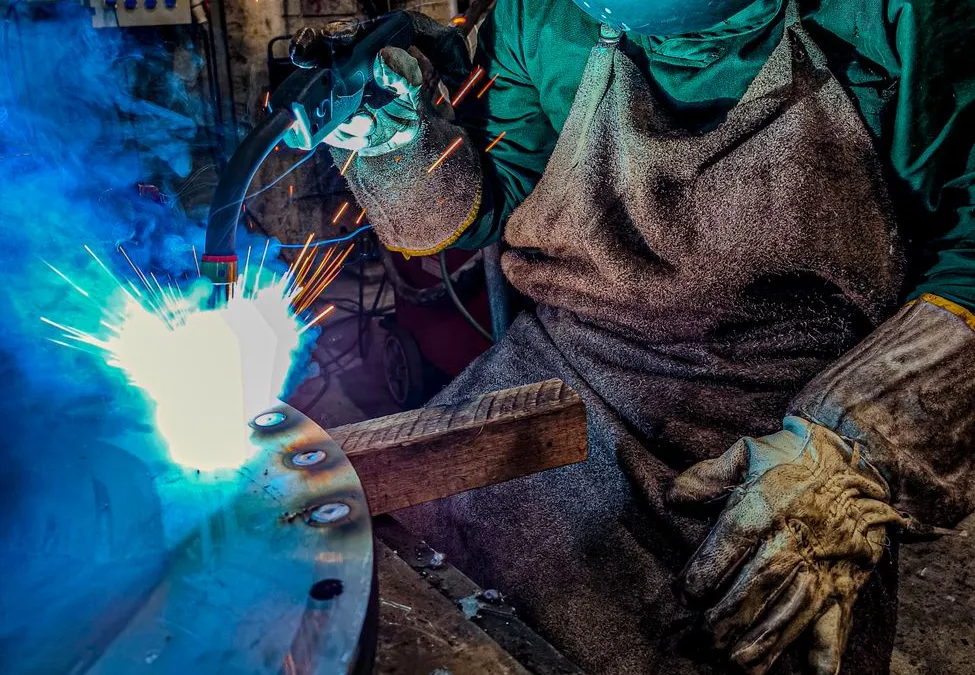
What is weld overlay cladding?
Weld overlay cladding deposits a layer of a different alloy onto the surface of a component by welding. The base metal carries the load and the pressure; the overlay faces the process medium or the wear. Cladding lets a part be made mostly in a cheaper, stronger or more weldable steel, with a more corrosion- or wear-resistant alloy only on the surfaces that need it.
An automatic machine moves the torch and the work at a steady, controlled rate, which gives a more even bead, thickness and dilution than manual welding. A cold-wire feeder adds filler wire to the weld pool without pre-heating it, which raises the deposition rate.
Weld overlay vs cladding: what is the difference?
Cladding is the general term for covering a base metal with a bonded layer of a different metal. Weld overlay is one way of doing it: the layer is built up by fusion welding, bead by bead, so it is metallurgically bonded to the part. Every weld overlay is cladding, but not all cladding is weld overlay.
Welding engineers usually separate the terms like this:
| Term | What it means | Typical use |
|---|---|---|
| Cladding | Any bonded layer of a different metal on a base metal: roll-bonded or explosion-bonded plate, laser cladding, or weld overlay | Corrosion-resistant surfaces on pressure equipment |
| Weld overlay (weld cladding) | Cladding deposited by fusion welding onto a finished shape | Flange faces, ring-joint grooves, valve bores and seat pockets |
| Hardfacing | A weld overlay chosen to resist wear rather than corrosion | Seats, guides and other wearing surfaces |
| Buttering | A weld layer put down to make a later weld possible, not to protect the surface in service | Joints between dissimilar metals |
Roll-bonded and explosion-bonded cladding is made mostly as plate, which suits vessel shells and heads. A casting has bores, grooves and faces, so on castings the cladding is applied by weld overlay. That is why valve and flange drawings use the two words for the same thing.
What makes a good overlay: dilution
As the overlay is welded, some of the base metal melts and mixes into it. This is dilution. It lowers the alloy content of the layer, which matters most for corrosion-resistant overlays: too much iron from a steel base reduces the corrosion resistance of a stainless or nickel-alloy surface.
Dilution is controlled by keeping the heat input low and steady and by building the layer in more than one pass, so that the surface left after machining has the chemistry the specification asks for. Many specifications set a maximum iron content at the finished surface of a nickel-alloy overlay, and welding procedures are qualified to codes such as ASME Section IX, typically with bend tests and a chemical analysis of the deposit. Tell us the limits your specification sets and we will confirm we can meet them.
Where cladding is used on valves and flanges
Across industry, overlay cladding is commonly applied to:
- Flange faces and ring-joint grooves that are in contact with a corrosive medium
- Valve body bores, seat pockets and sealing faces, where corrosion or erosion would cause leakage
- Surfaces that wear, such as seats and guides in abrasive service
The overlay alloy, its finished thickness and how it is inspected are always set by your drawing and specification.
Our equipment
| Item | Specification |
|---|---|
| Automatic overlay welding machine | With cold-wire feeder |
| Cladding thickness | 10 to 15 mm |
| Flange diameter | Ø200 to 550 mm |
| Welding | 600 A transformer-based |
| Welding and arc cutting | 600 A and 400 A rectifier-based |
| Fettling bay | Dedicated, 30 × 15 ft |
The cladding machine sits in the same bay as our cutting, welding and grinding, next to shot and sand blasting, so a clad casting goes on to heat treatment, inspection and machining without leaving the works.
What to tell us in your enquiry
- The base casting grade and standard, for example ASTM A216 WCB.
- The overlay alloy or specification your drawing calls for.
- The areas to be clad, marked on the drawing, and the finished thickness after machining.
- The inspection you need on the overlay, for example dye penetrant testing.
- Whether we should machine the part after cladding.
Frequently asked questions
How thick can you clad?
Our automatic overlay welding machine deposits cladding 10 to 15 mm thick.
What size flanges can you clad?
Flanges from Ø200 to 550 mm in diameter.
Which overlay alloys do you use?
The overlay alloy is set by your specification. Tell us the alloy and finished thickness your drawing calls for and we will confirm we can apply it.
Can you machine the part after cladding?
Yes. Clad castings can be machined in our CNC machine shop or by our machining partners and supplied ready to assemble.
What is the difference between weld overlay and cladding?
Cladding is any bonded layer of a different metal on a base metal. Weld overlay is cladding applied by fusion welding. On castings, flanges and valve parts the cladding is almost always a weld overlay, so the two terms are used for the same thing.
What is the difference between weld overlay cladding and hardfacing?
Both are layers deposited by welding. A cladding overlay uses a corrosion-resistant alloy to protect the surface from the process medium. Hardfacing uses a hard alloy to protect a surface from wear.
Need a clad flange or valve body?
Send the drawing with the base grade, overlay alloy and finished thickness.