
Unit II
Investment casting (lost wax casting)
In short
H.J. MetalCraft is an investment casting manufacturer in Ahmedabad, Gujarat, India. Our second unit makes investment castings, also called lost wax or precision castings, from 10 g to 50 kg, for small, detailed parts that need a fine surface and close-to-final shape. It sits alongside our sand foundry, which pours castings up to 180 kg, and our machine shop can finish the parts to your drawing.
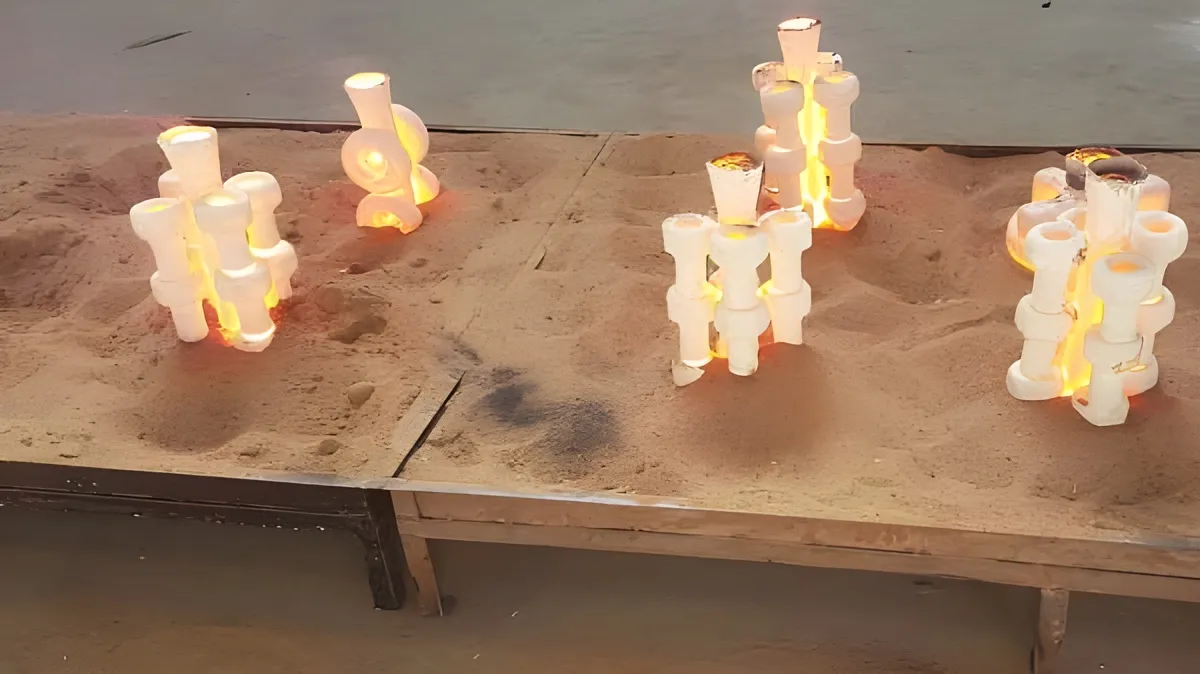
How investment casting works
Investment casting builds a one-off ceramic mould around a wax copy of the part. Because the mould is made in one piece and the wax is melted out, there is no parting line and no pattern to draw, so fine detail and thin sections reproduce well.
- Wax injection. Wax is injected into a metal die to make an exact wax copy of the part.
- Assembly. The wax patterns are fixed to a central wax runner to form a cluster, or tree.
- Shell building. The tree is dipped in ceramic slurry and coated with refractory sand, coat after coat, drying between layers, until the shell is thick enough to hold the metal.
- Dewaxing and firing. The wax is melted out and the empty shell is fired, which strengthens it and burns off any residue.
- Melting and pouring. The alloy is melted in an induction furnace and poured into the hot shell.
- Knock-out. Once the metal has solidified, the ceramic shell is broken away.
- Finishing. The castings are cut from the tree, ground, inspected and, where the drawing calls for it, machined.
Equipment at Unit II
| Stage | Equipment | Capacity |
|---|---|---|
| Wax room | Wax melting pot | 100 kg |
| Wax room | Wax mixing | 100 kg |
| Wax room | Wax auto-filling system | 150 kg |
| Wax injection | Auto press | 5 t |
| Wax injection | Wax injection presses (2) | 3 t each |
| Shell building | Jar mill (slurry) | 200 kg |
| Shell building | Rain-flow sanding machine | 50 kg |
| Shell building | Coating drums (3) | 250, 200 and 200 kg |
| Shell building | Fluidised bed with dust collector | 300 kg |
| Dewax and firing | Gas-fired tank | 200 kg |
| Dewax and firing | Shell firing furnace, 3 × 3 × 3 ft | 500 kg of shells |
| Melting | Induction melting furnace with hydraulic system | 50, 100 and 150 kg |
| Melting | Cooling tower | — |
| Finishing | Knock-out machine | — |
| Finishing | Bench grinders (2), belt grinder (1) | — |
| Services | Air compressors (2), 500 L air receiver | — |
Materials
We make investment castings in carbon and alloy steels, stainless steels and nickel-base alloys, to customer drawings and specifications. Tell us the grade and standard on your drawing and we will confirm it can be poured in Unit II at your part's size.
Machined investment-cast components
An investment casting comes out close to its final shape, so less metal has to be removed. Where faces, bores or threads need tighter tolerances, we finish the parts in our CNC machine shop or through our network of machining partners, and supply them ready to assemble.
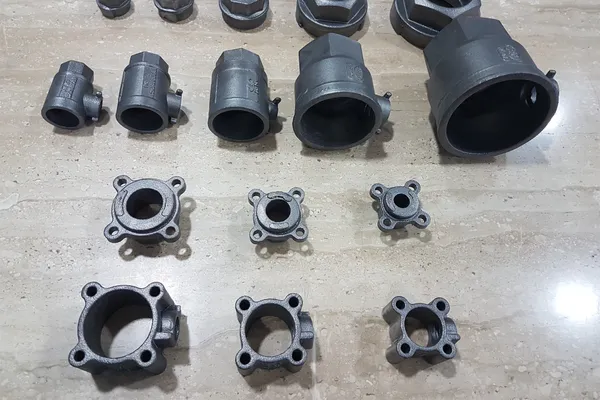
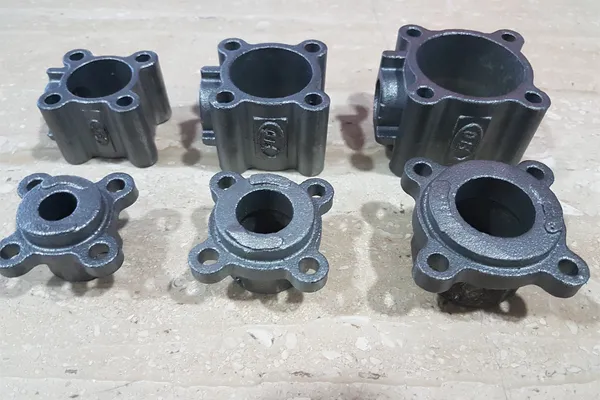
Investment-cast ball valve bodies
Two-piece ball valve bodies and end pieces in a range of sizes, cast in Unit II and ready for machining.
Sand casting or investment casting?
| Sand casting (Unit I) | Investment casting (Unit II) | |
|---|---|---|
| Weight per piece | Up to 180 kg | 10 g to 50 kg |
| Mould | CO2 or airset bonded sand, rammed around a pattern | Ceramic shell built on a wax copy, used once |
| Tooling | Pattern in teak wood, aluminium or CI from our pattern shop | Metal die for wax injection |
| Detail and surface | Good; machining allowance on working faces | Finer detail and surface; often less machining |
| Suits | Larger and heavier parts, thicker sections | Small, complex parts made in repeat batches |
| PED material certificate | Covered: sand castings up to 180 kg and 65 mm thick | Not covered: our PED certificate is for sand castings |
For a longer comparison, read sand casting vs investment casting: how to choose.
Frequently asked questions
What size investment castings can you make?
From 10 g to 50 kg per piece. Heavier parts, up to 180 kg, are made as sand castings in our main foundry.
When should I choose investment casting instead of sand casting?
Choose investment casting for small, detailed parts made in repeat batches, where a fine surface and a near-final shape save machining. Choose sand casting for larger or heavier parts and for low quantities, where a wax die would not pay for itself.
Does your PED certificate cover investment castings?
No. Our PED 2014/68/EU material-manufacturer certificate covers sand castings in ferritic, alloyed, austenitic and duplex steels up to 180 kg and 65 mm thick. Tell us at enquiry stage if your part needs PED material certification.
Can you machine investment castings?
Yes. We finish investment castings in our CNC machine shop or through our machining partners and supply them ready to assemble.
Small part, fine detail?
Send the drawing, grade and yearly quantity and we will tell you whether investment or sand casting suits it best.