
Material guide
Nickel-base alloy castings
In short
Nickel-base alloys are non-ferrous alloys, used where stainless and duplex steels are not enough: strong acids, hot chlorides, and very high temperatures. H.J. MetalCraft is a nickel alloy casting manufacturer in India, casting nickel-base alloys up to 180 kg to ASTM A494 and proprietary specifications, with chemistry verified on a CCD spectrometer set up for 24 nickel-base elements.
What are nickel-base alloys?
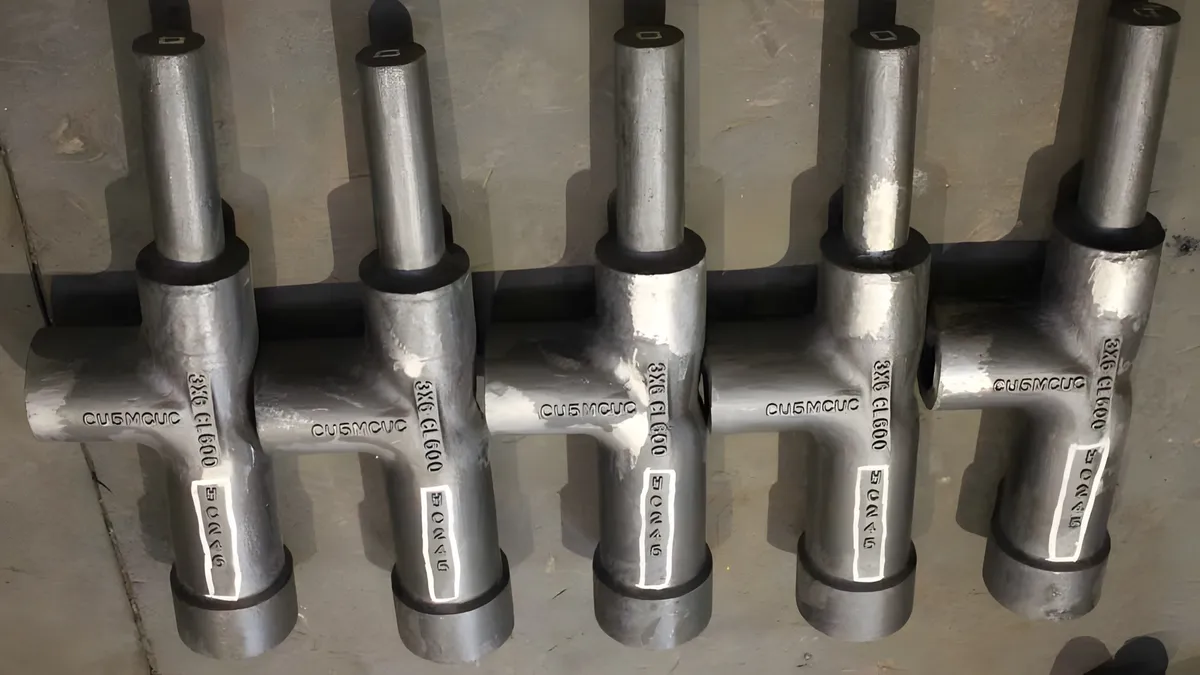
Nickel-base casting alloys contain more nickel than any other element, usually alloyed with copper, chromium, molybdenum or iron. Nickel-copper alloys handle seawater and hydrofluoric acid; nickel-molybdenum alloys resist hydrochloric acid; nickel-chromium-molybdenum alloys combine resistance to oxidising and reducing media, pitting and crevice corrosion. ASTM A494 covers most cast nickel grades, and many correspond to well-known wrought alloys.
Commonly specified grades
| Grade | Standard | Family | Wrought counterpart | Typical use |
|---|---|---|---|---|
| CZ-100 | ASTM A494 | Nickel | Nickel 200 | Caustic alkalis |
| M35-1 | ASTM A494 | Ni-Cu | Alloy 400 (Monel type) | Seawater, hydrofluoric acid |
| CY-40 | ASTM A494 | Ni-Cr-Fe | Alloy 600 | High-temperature and caustic service |
| CW-6MC (CW6MC) | ASTM A494 | Ni-Cr-Mo-Nb | Alloy 625 (Inconel type) | Severe chloride and acid service |
| CU5MCuC | ASTM A494 | Ni-Fe-Cr-Mo-Cu | Alloy 825 (Incoloy type) | Sulphuric and phosphoric acid service |
| CW-12MW (CW12MW) / CW-2M (CW2M) | ASTM A494 | Ni-Mo-Cr | C-276 / C-4 (Hastelloy type) | Mixed acids, wet chlorine |
| N-12MV / N-7M | ASTM A494 | Ni-Mo | B / B-2 (Hastelloy type) | Hydrochloric acid |
Where nickel-alloy castings are used
- Chemical processing: pump casings, impellers, valves and fittings for acids and chlorides
- Oil and gas: sour and high-chloride service where stainless steels crack or pit
- Power generation: flue-gas desulphurisation and high-temperature components
Precision in the melt
Nickel alloys are expensive and unforgiving of contamination, so composition control is everything. Our CCD spectrometer is set up for nickel-base analysis, covering 24 elements in nickel-base alloys, alongside 32 elements, including nitrogen, in ferrous alloys. Castings are checked by dye penetrant and radiography to confirm soundness.
Tips for your enquiry
- Give the exact grade and standard, or the wrought alloy you want to match.
- Describe the medium, concentration and temperature if you need advice.
- List any heat-treatment, corrosion-test or certification requirements.
Frequently asked questions
What is ASTM A494 CW-6MC?
CW-6MC is a cast nickel-chromium-molybdenum-niobium alloy, the cast counterpart of Alloy 625. It is used for pumps, valves and fittings in severe chloride and acid service.
When should I use a nickel alloy instead of duplex stainless steel?
Choose a nickel alloy when the medium is too aggressive for duplex: for example hot concentrated acids, hydrochloric acid, wet chlorine or very high temperatures. Send us the service conditions and we can suggest options.
Can you analyse nickel-base chemistry in-house?
Yes. Our CCD spectrometer covers 24 elements in nickel-base alloys.