
Material guide
Duplex and super duplex steel castings
In short
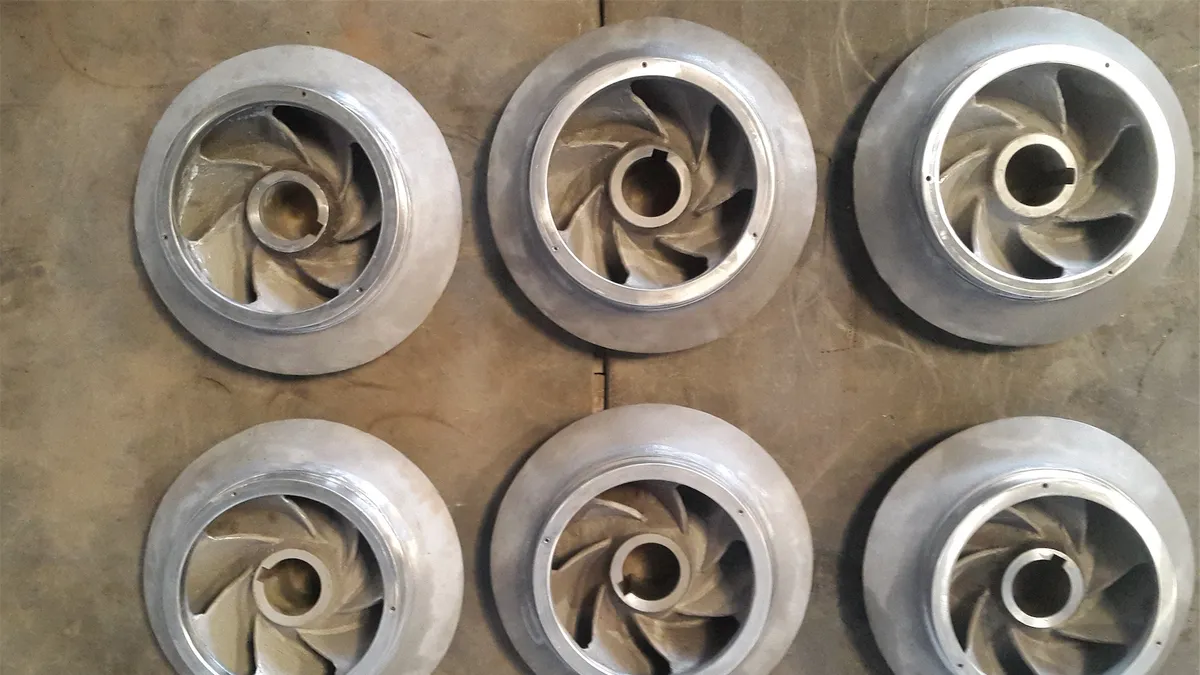
Duplex stainless steels have a mixed austenite-ferrite structure that gives roughly twice the yield strength of 316 stainless together with excellent resistance to chloride pitting and stress corrosion cracking. H.J. MetalCraft manufactures duplex and super duplex steel castings in India, to ASTM A890 and A995 grades 4A, 5A and 6A, up to 180 kg.
What is duplex stainless steel?
Duplex steels balance roughly equal amounts of austenite and ferrite. The result is a stainless steel that is much stronger than standard austenitic grades and far more resistant to chloride stress-corrosion cracking. Super duplex grades raise chromium, molybdenum and nitrogen further for seawater and other severe chloride service. Pitting resistance is often compared by PREN (Cr + 3.3Mo + 16N), which makes nitrogen control during melting essential.
Commonly specified grades
| Grade | Standard | Type | Typical use |
|---|---|---|---|
| 1B (CD4MCuN) | ASTM A890 / A995 | 25Cr duplex with copper | Pumps for abrasive, corrosive slurries |
| 3A (CD6MN) | ASTM A890 | 25Cr duplex | General corrosion service |
| 4A (CD3MN) | ASTM A890 / A995 | 22Cr duplex (2205 type), 1.4470 | Valves, pumps, chemical process |
| 5A (CE3MN) | ASTM A890 / A995 | 25Cr super duplex (2507 type), 1.4469 | Seawater, offshore, desalination |
| 6A (CD3MWCuN) | ASTM A890 / A995 | 25Cr super duplex with W and Cu | Seawater and firewater systems |
A note on grade names. Under ASTM A890 and A995, the 2507-type super duplex is Grade 5A (CE3MN), while Grade 6A (CD3MWCuN) is a super duplex with added tungsten and copper. We cast 4A, 5A and 6A: put the grade number and UNS designation on your drawing so there is no doubt which you need.
Where duplex castings are used
- Oil exploration and offshore: valve bodies, pump casings and impellers in seawater and produced-water service
- Chemical processing: parts exposed to chlorides, acids and stress-corrosion conditions
- Desalination and water: pumps and valves handling brine
Why process control matters
Duplex steels must be melted to tight chemistry, including nitrogen, then solution-annealed and rapidly quenched to keep the right phase balance and avoid embrittling phases. Our CCD spectrometer measures nitrogen along with up to 32 elements, and our agitated 14,000-litre quench tank delivers the fast quench these grades need.
Tips for your enquiry
- Give the grade and whether ASTM A890 or A995 (pressure-containing) applies.
- Specify any ferrite-content range, PREN minimum or corrosion test (for example ASTM G48).
- State impact-test temperature if required.
Frequently asked questions
What is the difference between duplex and super duplex castings?
Super duplex grades such as ASTM A890 5A have higher chromium, molybdenum and nitrogen than standard duplex grades such as 4A, giving a higher pitting resistance (PREN above 40) for seawater and severe chloride service.
Why choose duplex over 316 stainless?
Duplex has about twice the yield strength of 316 and much better resistance to chloride pitting and stress-corrosion cracking, so parts can be lighter and last longer in salty or chloride-bearing media.
Do you measure nitrogen in duplex steel?
Yes. Our CCD spectrometer analyses nitrogen along with up to 32 elements in ferrous alloys.