
Process
Sand casting vs investment casting: how to choose
Both processes make steel castings to drawing, but they suit different parts. Here is how to tell which one fits yours.
· H.J. MetalCraft technical team
We run both processes: sand casting in our main foundry, for parts up to 180 kg, and investment casting in our Unit II, for parts from 10 g to 50 kg. Customers often ask which they should use. The answer depends on the part, the quantity and the paperwork.
How each process works
Sand casting packs bonded sand around a pattern to form a two-part mould with a parting line. Cores form internal passages. After pouring, the sand is broken away and reclaimed. We use the CO2 and airset processes; see CO2 vs airset moulding.
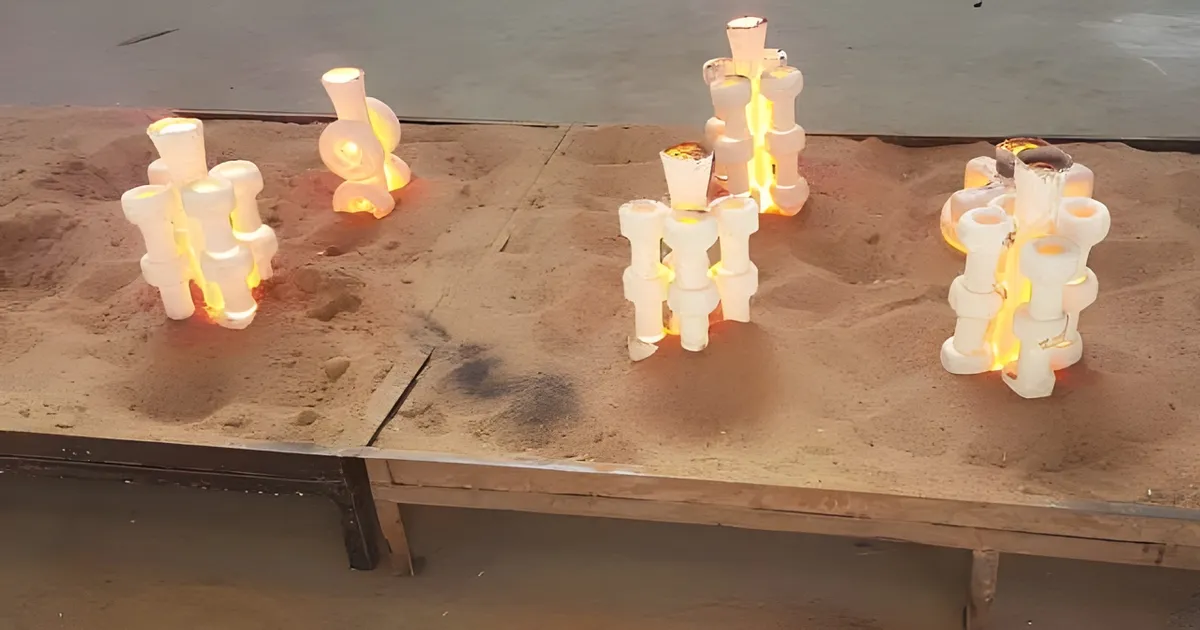
Investment casting injects wax into a metal die to make a copy of the part, assembles the copies into a tree, and builds a ceramic shell around it, coat by coat. The wax is melted out, the shell is fired, and metal is poured into the hot shell. The shell is broken off afterwards and used only once. See investment casting for our process and equipment.
Side by side
| Sand casting | Investment casting | |
|---|---|---|
| Part size | Medium to large | Small to medium |
| Our weight range | Up to 180 kg | 10 g to 50 kg |
| Tooling | Pattern and core boxes (wood, aluminium, CI) | Metal die for the wax |
| Tooling cost | Lower | Higher |
| Best quantity | One-offs to medium batches | Repeat batches |
| Detail and thin walls | Good | Finer |
| Surface finish | Good | Smoother |
| Machining needed | Allowance on working faces | Often less, close to final shape |
| Parting line | Yes | No |
These are general tendencies, not rules; a well-designed sand casting can beat a poorly designed investment casting.
Five questions to decide
- How big and heavy is it? Above 50 kg, it is a sand casting in our works. Below a few kilograms, investment casting becomes attractive.
- How many will you buy? A wax die costs more than a pattern. It pays back over repeat batches, much less so over a handful of parts.
- How much detail does it have? Fine features, lettering, thin ribs and complex outside shapes favour investment casting.
- How much machining can you save? If investment casting removes machining operations, the higher casting price can still give a lower finished-part cost.
- What certification do you need? Check the foundry's certificate scope. Our PED material-manufacturer certificate covers sand castings only, so a PED pressure part from us will normally be a sand casting.
Still not sure?
Send us the drawing, material grade and annual quantity. We will tell you which process suits the part and, where both would work, compare them for you. See what PED certification means for casting buyers if the part is for European pressure equipment.
Have a casting in mind? Send us the drawing.
Request a quote