
Process
CO2 vs airset moulding for steel castings
Both are chemically bonded sand processes we use for moulds and cores. Here is how they differ, and why it matters for your casting.
· H.J. MetalCraft technical team
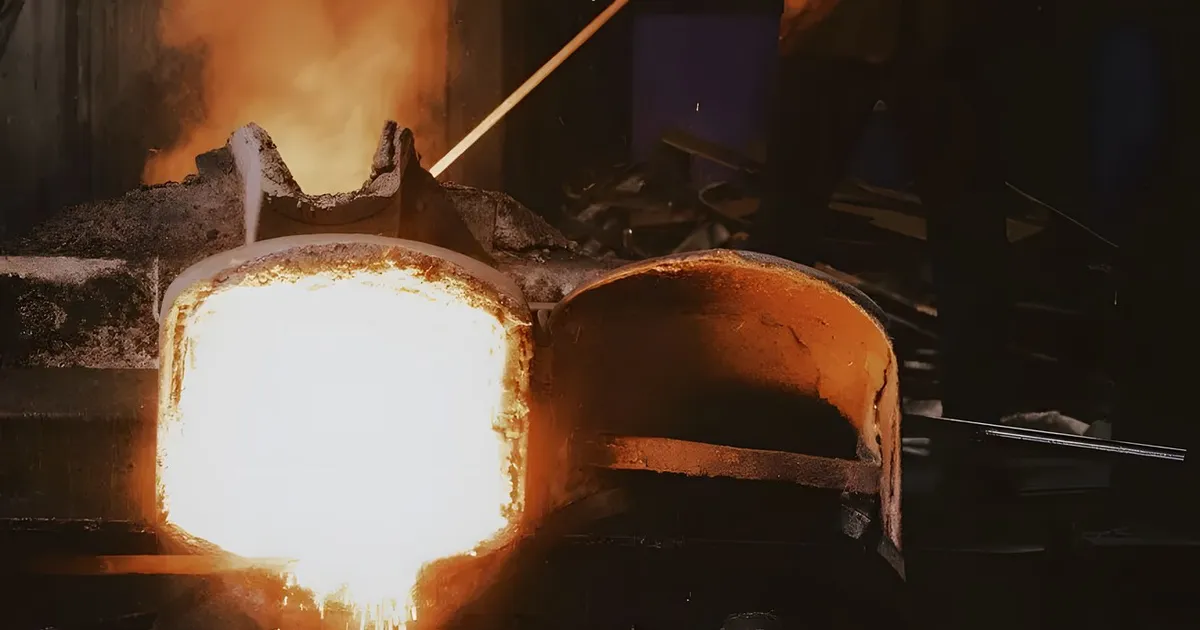
Steel castings are poured at very high temperatures, so the mould must be strong, dimensionally stable and able to release gas. Chemically bonded sands do this far better than traditional clay-bonded green sand. At our foundry we use two: CO2 and airset.
The CO2 process
Silica sand is mixed with sodium silicate (water glass) and rammed around the pattern. Carbon dioxide gas is then passed through the sand, reacting with the silicate to harden the mould in seconds.
Strengths: fast, low binder cost, odour-free, good for heavy sections and cores. Watch-outs: sand can be harder to knock out after casting (we add a collapsible agent), and moulds absorb moisture if stored too long.
The airset (no-bake) process
Sand is mixed with a resin and a catalyst. The mixture self-hardens at room temperature over minutes, with no gassing needed.
Strengths: excellent dimensional accuracy and surface finish, strong moulds, easy knock-out and good sand reclamation. Watch-outs: higher binder cost, and resin choice must suit the alloy.
Side by side
| CO2 (sodium silicate) | Airset (resin no-bake) | |
|---|---|---|
| Hardening | CO2 gas, seconds | Self-sets, minutes |
| Surface finish | Good | Very good |
| Dimensional accuracy | Good | Very good |
| Knock-out | Harder (helped by collapsible agent) | Easy |
| Sand reclamation | Limited | Good |
| Binder cost | Low | Higher |
How we use them
We run both processes for moulds and cores, choosing per job. Our moulding shop has a sand mixer and muller (150 kg/batch, 1 t/hr each) and a 500 kg/hr sand reclamation unit, with mould boxes from 300 × 300 × 85 mm up to 1100 × 1000 × 230 mm. Exothermic sleeves and chills help feed thick sections so pressure parts come out sound.
See our capabilities for the full equipment list.
Have a casting in mind? Send us the drawing.
Request a quote